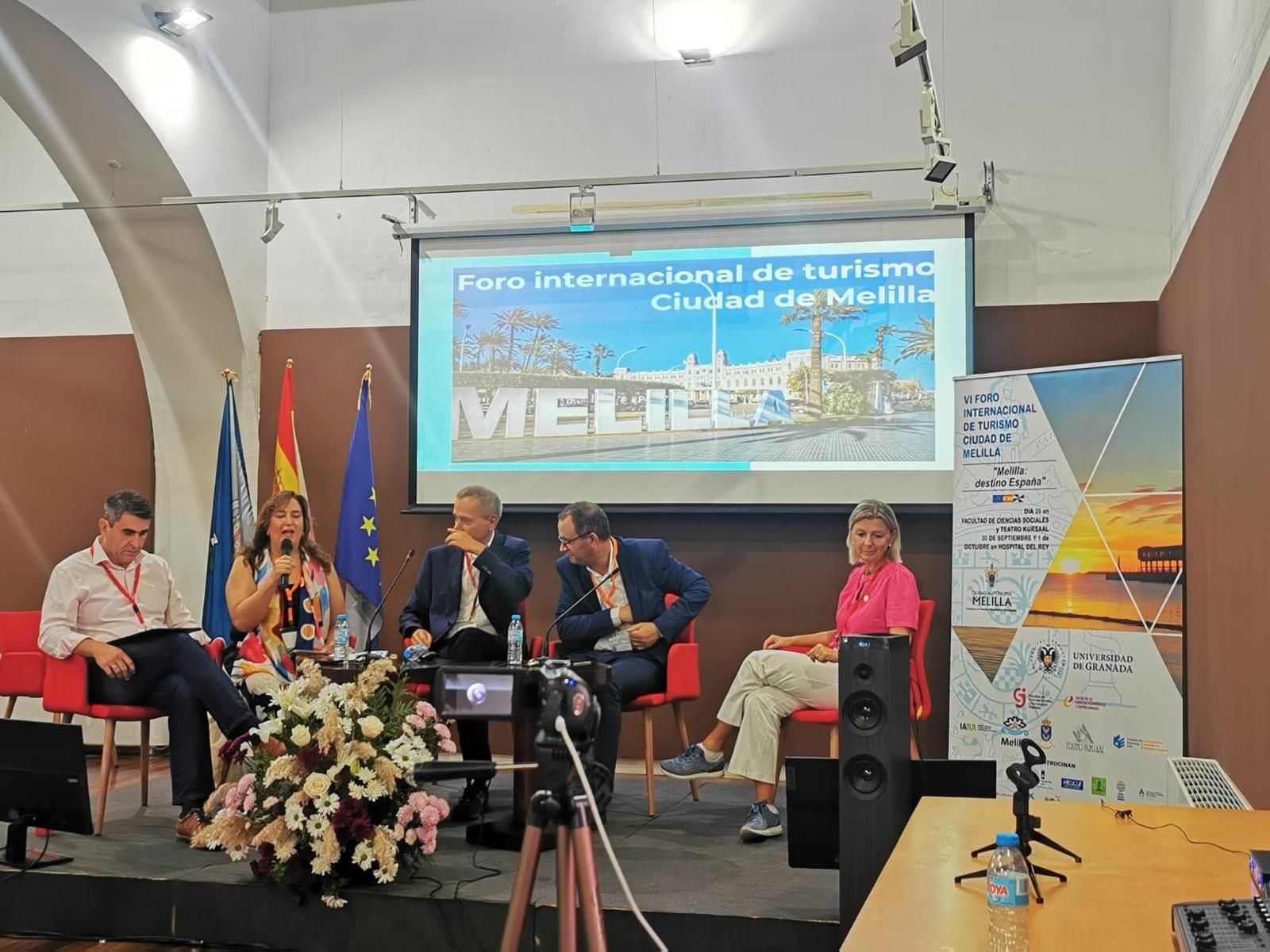
HERIT ADAPT was presented at the 6th International Tourism Forum of the City of Melilla, an international meeting bringing together institutions, tourism professionals, researchers and experts to discuss current challenges and new approaches in tourism development.
Ana García López, professor at the University of Granada and UGR lead for HERIT ADAPT, presented the experience developed by the University within the project and introduced the new transfer phase, in which Melilla participates as an Associated Partner and receiver territory linked to the University of Granada.
Under the approach “From storytelling to the journey”, the presentation explored how cultural heritage interpretation can move beyond the communication of isolated monuments and become a tool for connecting places, communities and visitor experiences across a wider territory.
The UGR experience within HERIT ADAPT was presented through the pilot developed between the Alhambra and the watchtower network of Western Granada, where territorial research, local participation, heritage interpretation, audiovisual storytelling and digital technologies were combined to encourage visitors to discover lesser-known heritage sites beyond highly visited destinations.
A central example was The Voice of the Towers, an AI-supported audiovisual storytelling project developed as part of the UGR pilot. Rather than being conceived as an isolated communication product, the initiative was integrated into a broader methodology that included digital and printed guides, walking and cycling routes, territorial interpretation, participatory activities and engagement with local communities.
The presentation highlighted one of the main lessons emerging from the project: sustainable tourism strategies can move “from the point to the network”, connecting individual heritage assets within broader territorial narratives instead of treating them as isolated destinations. In this way, storytelling becomes not only a means of interpretation, but also a tool for influencing visitor routes, redistributing tourism flows and strengthening connections between heritage, landscape and local communities.
Participants at the Forum were also invited to interact with the digital tourism guide developed within the UGR pilot, accessible through a QR code during the presentation, allowing them to experience first-hand how storytelling, routes and heritage information can be integrated into a single digital visitor experience.
The presentation also introduced HERIT ADAPT, the new transfer-oriented phase of the project. Building on the methodology already developed and validated in HERIT ADAPT, the new phase focuses on adapting this knowledge to different Mediterranean contexts rather than replicating previous pilots.
Melilla will play a particularly relevant role in this process. Its geographical position between Europe and North Africa, its intercultural identity and its rich historical and defensive heritage provide a distinctive context in which to explore how HERIT ADAPT tools and methodologies can be adapted to new territorial and tourism challenges.
The transfer process will involve identifying suitable heritage contexts, working with local stakeholders, assessing local needs and opportunities, adapting relevant components of the HERIT ADAPT methodology and developing targeted training and capacity-building activities.
For Ana García López, the Melilla case also offers an opportunity to explore how new narratives can contribute to the construction of more meaningful tourism experiences:
“The challenge is not simply to tell the story of a heritage site, but to use storytelling to connect places, create routes and encourage visitors to experience a territory in a different way. HERIT ADAPT gives us the opportunity to transfer that approach while allowing each territory to define its own narrative and priorities.”
The participation in the Forum represents an important dissemination and stakeholder-engagement action for HERIT ADAPT in Melilla and complements the institutional work already underway between the University of Granada and the Autonomous City to prepare the next stages of the transfer process.
Source: Canal UGR | Noticias, convocatorias, eventos de la Universidad de Granada