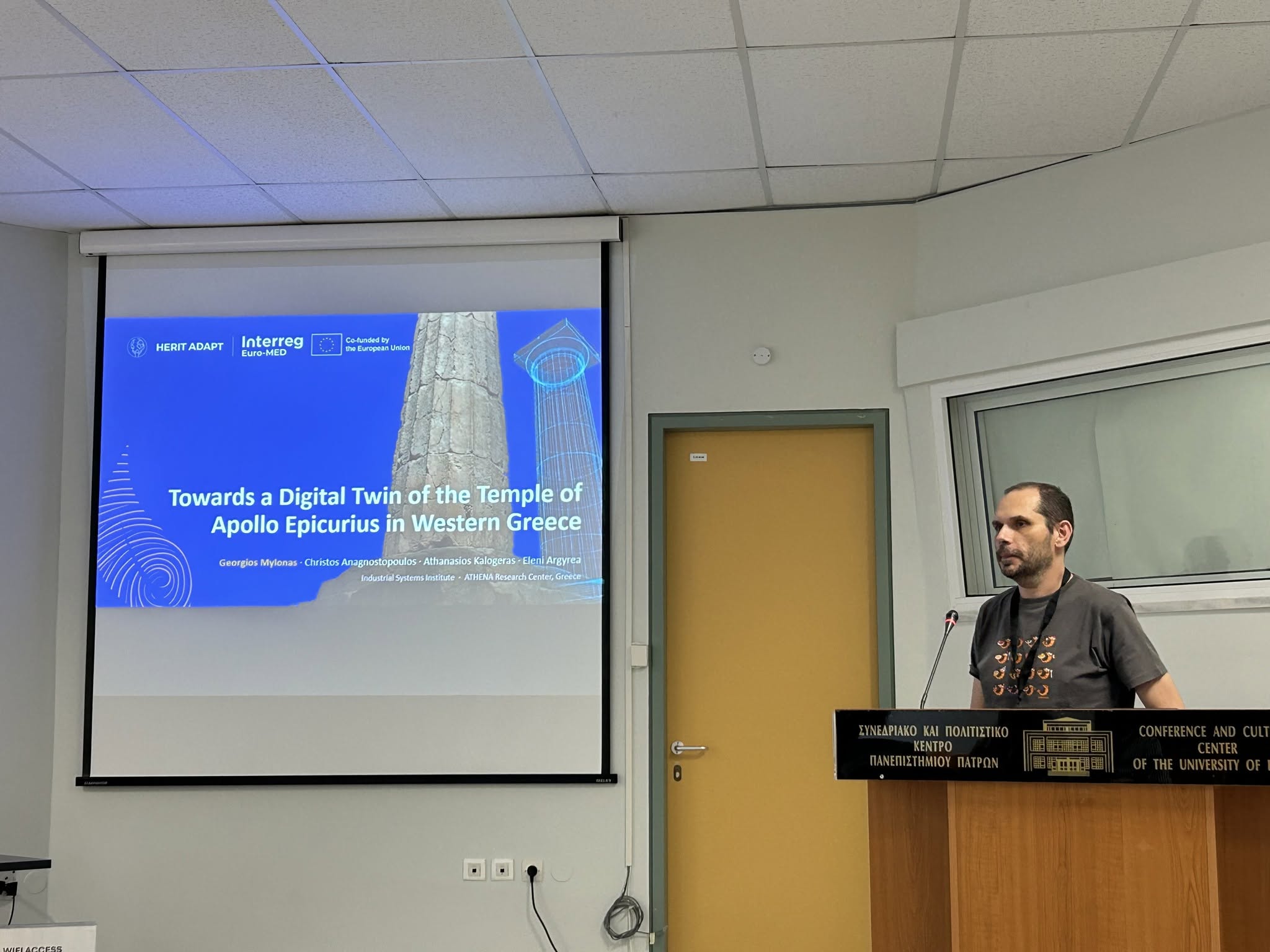
On 16 June, the HERIT ADAPT project was presented at the 11th International Conference on Tourism & Leisure Studies, held in Patras, Greece. The conference is an established international academic forum that brings together researchers, policymakers, and practitioners to discuss current trends, challenges, and innovations in tourism, leisure, and sustainable destination development.
Within this context, HERIT ADAPT contributed to the dialogue on how digital technologies can support the protection and sustainable management of cultural heritage in sensitive and remote locations.
The presentation was delivered by Georgios Mylonas, researcher at the Industrial Systems Institute / Research Centre ATHENA, who introduced the project’s pilot activities carried out at the Temple of Apollo Epicurius at Bassae, a UNESCO World Heritage Site located in the mountainous landscape of Western Greece.
The work demonstrated how an integrated set of advanced digital technologies was applied to create a comprehensive digital twin of the monument. Using drone photogrammetry and AI-driven 3D modelling, the team developed highly detailed representations of the temple, enabling new approaches to documentation, analysis, and interpretation.
Among the key results presented were innovative processes such as the digital removal of scaffolding from 3D models and the virtual restoration of architectural elements. These techniques enhance the visualisation of the monument’s original form and support more engaging and accessible heritage interpretation for both researchers and the wider public.
The presentation highlighted how these tools contribute to more sustainable tourism by improving access to fragile heritage sites without increasing physical pressure on them. By enabling remote exploration and enhanced storytelling, the approach helps bring the Temple of Apollo Epicurius closer to visitors while preserving its integrity.
This work reflects the broader mission of HERIT ADAPT within the Interreg Euro-MED Programme: to enhance tourism sustainability at vulnerable heritage sites through digital innovation, supporting a more balanced, informed, and resilient approach to cultural heritage management.